
Clay County Jail Mugshots Overview
A mugshot is the booking photo taken during jail intake. The Clay County Sheriff's Office runs the public inmate roster through its Police-to-Citizen (P2C) portal, and that roster carries booking-image support. On June 3, 2026, the public roster returned a setting that turns images on, and sample records carried image IDs. So the roster can show a booking photo for a current inmate. Many entries display a booking image when one is available. Not every entry has a visible photo, since a fallback marks records with no image on file.
There is no separate official Clay County mugshot gallery. The sheriff's office does not publish a daily booking-photo report or a recent-arrests photo feed. The P2C app has technical routes for recent arrests and wanted persons, but those modules were not enabled when the roster was checked. The booking image lives inside the inmate's roster profile, loaded by an image ID. How long a photo stays public is not posted by the sheriff's office, so no fixed retention window is stated here. Once a person leaves custody, the roster entry can drop off, and the photo with it.
Where to Find Clay County Booking Photos
The roster is the front door. The Clay County Sheriff's Office links the public to its P2C inmate catalog, a free search tool with no login. Booking photos load inside each inmate's profile when an image is on file. There is no gallery to scroll, so a search by name or other detail is how a record is found. If the person is no longer listed, the image will not load, and a public-records request becomes the route to an arrest booking photograph. The jail can also be reached by phone when a roster result is unclear.
- Open the official Clay County P2C Inmates Catalog in a browser.
- Search by last name, first name, middle name, age, charge, arrest date, race, or sex, or browse the current results.
- Open or expand the inmate card to view the booking photo, demographics, charges, court date, and bond.
- Confirm the person by name plus age, race, sex, height, weight, arrest date, charge, and court date.
- If the person is not listed, file a public-records request with the sheriff's office for the arrest booking photograph.
The roster runs as a live app, not a static page or a downloadable PDF. Results update as new bookings are processed, and on June 3, 2026 the catalog held 345 public records. A booking image is one field among many, so an image is helpful but not a substitute for the full record. The other fields confirm who the person actually is.
What a Clay County Booking Photo Shows
A Clay County booking photo never stands alone. The roster pairs the image with demographic and booking fields drawn from the intake record. The mugshot itself is a single front-facing image loaded by an image ID, not a gallery of angles. Around it sit the name, physical descriptors, arrest date, court date, primary charge, the full charge list, and bond detail. Some fields exist in the data but are hidden by the sheriff's display settings, such as date of birth, home address, and holding facility. The table lists the fields that appear with the photo.
| Field | What It Shows |
|---|---|
| Booking Photo | A single front-facing booking image loaded by image ID when one is on file; a no-image fallback shows when none is available. |
| Name | Last, first, middle, and suffix when present, shown as LAST, FIRST MIDDLE. |
| Demographics | Race, sex, age, height, and weight; date of birth exists in the data but is hidden. |
| Booking Date | The arrest and booking date for the current stay; same-day bookings appear quickly. |
| Court Date | The next court date when one is set, such as a first-appearance time. |
| Charges | Primary charge code and plain description, plus a per-charge list with status, docket number, and bond. |
| Booking Agency | The agency that booked the person, shown as Clay County Sheriff's Office. |
The photo helps a viewer match a face to a name, but the other fields do the real confirming. A person held on a probation violation may show a no-bond status and a linked docket number, while a brand-new booking may show an awaiting-bond status and no docket yet. Scars, marks, and tattoos may also display. The full set of fields is the reason to treat the record as a whole, not the image by itself.
Are Clay County Jail Mugshots Public Record?
In Florida, arrest and jail records are public records under a broad open-records law, and a booking photo held by the sheriff is part of that record. The Clay County Sheriff's Office shows booking images on the public roster, which reflects that openness. The law is broad but not absolute. Some categories are exempt or confidential, so not every record or image is released. Florida also has a separate statute aimed at commercial mugshot websites, which is often misread as a ban on the sheriff releasing photos. It is not. The statute creates a removal process against certain publishers, while the sheriff's own booking record stays a public record unless an exemption applies.
Key Statutes:
Fla. Stat. Ch. 119 - Florida's public-records law gives the public a right to inspect and copy nonexempt agency records, including most jail booking records and booking photos held by the sheriff.
Fla. Stat. § 901.43 - Sets up a removal process for arrest booking photographs published by certain commercial websites; it does not bar the sheriff from releasing booking records and is not automatic expungement.
Read narrowly, the booking-photo statute targets the commercial sites that post arrest photos and then charge people to take them down. It gives a subject a path to demand removal from those publishers. It does not erase the underlying arrest, does not seal the court case, and does not stop the sheriff's office from honoring a lawful public-records request. The two ideas are easy to confuse, so it helps to keep them apart: the open-records law governs what the government holds, while the removal statute governs what a private website must do when asked.
What Stays Public and What Is Withheld
The open-records law comes with a list of exemptions. Those exemptions are why a booking record or photo is sometimes withheld or partly redacted, even though most are public. Florida's exemption statute can shield juvenile information, confidential victim data, protected addresses, and records tied to an active investigation. Sealed and expunged records are also removed from public access by court order. The roster itself already hides some fields by design, such as date of birth and home address, which are display choices on top of the legal rules.
What is and isn't public: The public can see a current inmate's name, race, sex, age, height, weight, arrest date, court date, charges, bond, booking agency, and a booking photo when one is on file. Hidden or withheld items include date of birth, home address, arresting agency, arrest notes, holding facility, and anything covered by a Section 119.071 exemption such as juvenile, victim, active-investigation, or sealed and expunged records.
One practical point matters more than any single field. A booking photo alone can lead to mistaken identity. Two people can share a name and a rough look. Before treating a photo as a match, compare the name against age, race, sex, height, weight, arrest date, the charge, and the court date. The roster publishes those exact fields so a viewer can verify rather than guess. Note: a booking record reflects an arrest, not a conviction, and a charge can later be reduced, dropped, or never filed in court.
How to Request a Clay County Booking Photo
When a person is no longer on the roster, the booking photo is requested through the sheriff's public-records process. The Clay County Sheriff's Office accepts requests several ways, and a requester may stay anonymous and need not state a reason. Asking specifically for the "arrest booking photograph" by name and arrest date helps staff locate the right file. The custodian of records handles these requests through the Public Records Section.
Below is a screenshot of the sheriff's online public-records portal, where many requests start. You can reach the CCSO GovQA public-records portal to open and track a request.
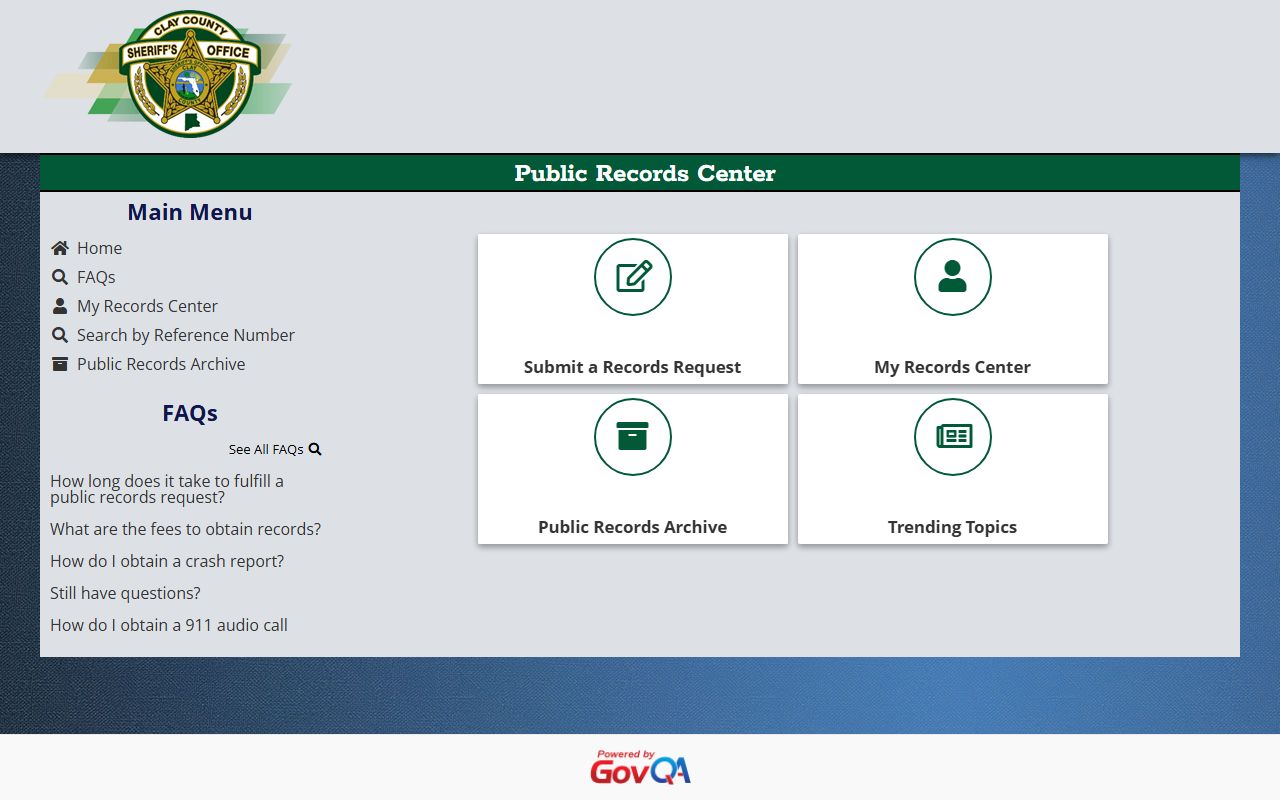
The GovQA portal lets a requester submit the request, attach detail, and follow its status online. Phone, mail, and in-person options exist for anyone who prefers them.
- Submit online through the CCSO GovQA public-records portal, the route most requesters use.
- Call the Public Records Section at (904) 529-6090 to make or check a request by phone.
- Mail a request to Clay County Sheriff's Office, Attn: Public Records Section, 901 N. Orange Ave., Green Cove Springs, FL 32043.
- Request in person at the David White Memorial Building, 901 N. Orange Avenue, or at any CCSO substation.
Give the person's full name and the arrest date, and state that you want the arrest booking photograph. Florida law lets the agency charge a reasonable cost for copies and for extensive staff time, so a fee may apply depending on the request. Records that fall under an exemption may be withheld or redacted. For a current inmate, the faster path is still the live roster, where the image loads inside the profile at no cost.
Mugshot Removal and Sealed Records
Removing a booking photo is not the same as clearing a record, and the two follow different paths. Florida's booking-photo statute lets a person demand that certain commercial websites take down an arrest photo, often after a request and within a set time. That process targets the private publishers that post photos and charge fees, and it does not name or endorse any such site. It also does not touch the sheriff's own record or the court file. To address the underlying case, a person uses Florida's sealing and expunction process instead.
Sealing and expunction are court-ordered remedies for qualifying cases, often after a dismissal, an acquittal, or a no-file decision by the prosecutor. When a record is sealed or expunged, it is removed from public access, and agencies that hold it are directed to restrict or destroy it under the order. That is the real route to take a booking record out of the public view, and it is handled through the courts, not through a website fee. The steps and eligibility for that process are covered with sealing and expunging an arrest record in more detail. For the custody side of the same record, the Clay County jail inmate records route explains what the roster shows and how long a person appears on it.
Federal and State Booking Photos
The county roster is only one of several custody systems, and they handle photos differently. Sentenced Florida state prisoners are tracked by the Florida Department of Corrections, not the county jail. The state offender search may show a profile photo for a person in state prison, which is a different image from a county booking photo. A person moves from the Clay County Jail to state custody only after sentencing and transfer, so the county roster can drop them while the state locator picks them up.
Federal custody works differently again, and there is no public federal mugshot gallery. The federal locators are finders, not photo feeds. The image below shows the Bureau of Prisons inmate locator, a federal search tool. You can open the BOP inmate locator to look up a federal inmate by name or number.
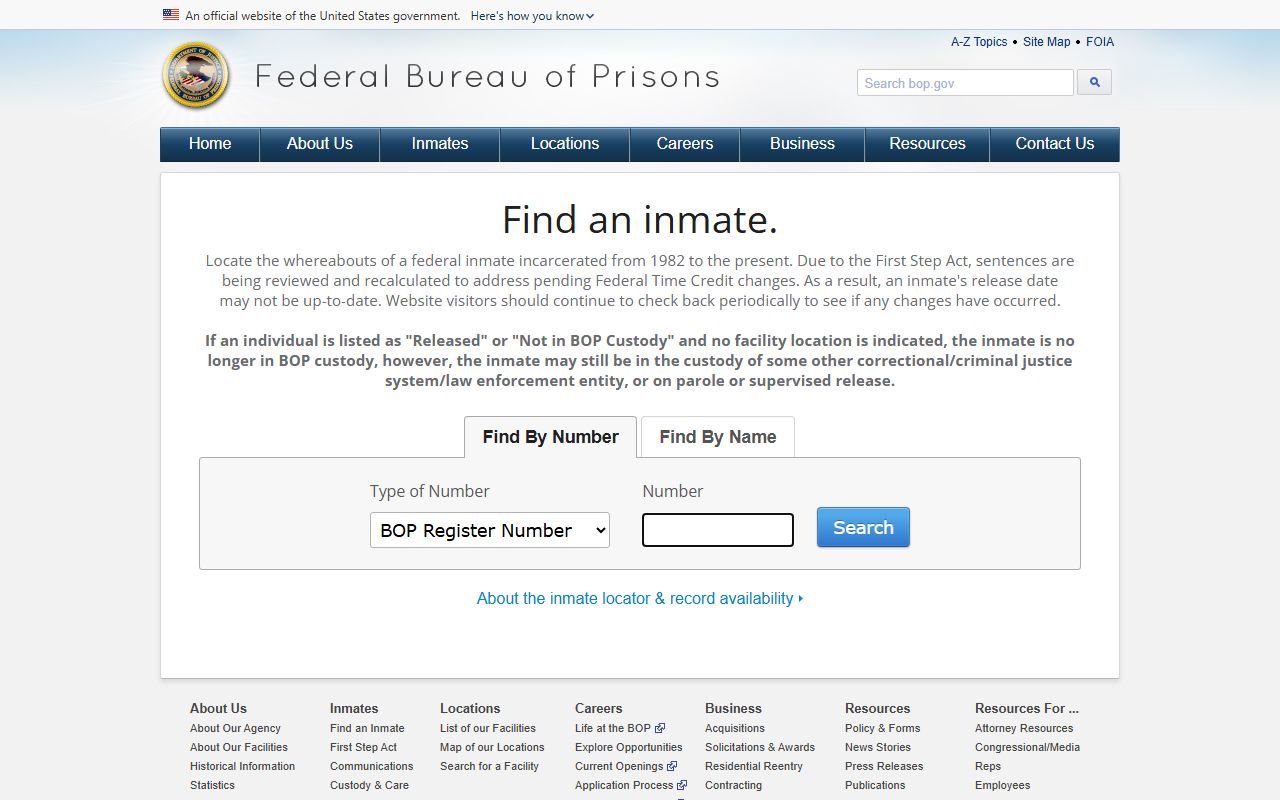
The BOP locator returns custody status and facility detail, but it does not publish booking photos to the public. The U.S. Marshals handle federal pretrial custody and also do not run a public mugshot gallery, and the ICE detainee locator is a custody finder rather than a photo database. So a county booking photo, a state prison profile, and a federal record are three separate things. Note: matching a photo across systems is unreliable, so confirm identity with names, dates, and case numbers rather than an image alone.