
Clay County Court Records After a Jail Arrest
An arrest in Clay County starts a chain that runs through three offices. The Clay County Sheriff's Office books the person into the jail. The State Attorney for the Fourth Judicial Circuit reviews the case and files the charges. The Clay County Clerk of Court holds the court record once the case opens. The arrest is the trigger. The court record is the result. A booking shows quickly on the jail roster, often the same day, with a charge code, a status such as PRE-TRIAL, a court date, and a bond figure. The formal court case may take longer to appear, because the prosecutor must first decide what to file.
The booking side and the court side answer different questions. For custody, bond, and booking detail, the roster and the jail inmate records page cover where a person is held and what the intake record shows, and the jail roster mugshots page covers booking photos. The court record is something else. It is the case the prosecutor filed after the arrest, tracked by the Clerk through charges, hearings, bond orders, and the final outcome. One person can have an open jail record and a separate court record at the same time, and the wording on each may not match.
How to Find Clay County Court Records After an Arrest
Court records live with the Clerk, not the jail. The Clerk's Search Records and Reports page is the official starting point for court and official records, and it routes to the court inquiry portal where filed cases can be looked up. The portal lets the public search an open case by the defendant name or by the case number once a number exists. The jail roster is where the booking charge, arrest date, and any early docket number show up, so many people start there to grab the case number before moving to the Clerk.
The exact field labels on the inquiry portal are not confirmed here, so treat the steps below as the general flow rather than a screen-by-screen script. The portal is the official lookup, and the Clerk's Criminal Court Services department handles questions about criminal files that are not clear online.
- Open the Clerk's court inquiry portal from the Search Records and Reports page.
- Search by the defendant name, or by the case number if the jail roster already showed one.
- Open the matching case and read the list of charges the prosecutor filed.
- Check each charge for its code, its level, and its current status.
If a name search returns nothing soon after an arrest, the case may not be filed yet. Give the prosecutor time to review and file, then search again by name. For records that are old, sealed, or not online, contact the Clerk directly. For prosecution files, the State Attorney's Office runs its own public-records process, separate from the Clerk and the Sheriff.
How Charges Get Filed After an Arrest
The court record opens when a charging document is filed, and that document is what turns a booking into a case. Police book the person and send their reports to the prosecutor. The State Attorney then decides what, if anything, to charge. Florida uses State Attorneys, not county district attorneys, so the charging authority for Clay County is the State Attorney for the Fourth Judicial Circuit, which also covers Duval and Nassau. State Attorney Melissa W. Nelson leads that office, and First Assistant Jay Plotkin oversees the Clay and Nassau work.
Three charging documents start most cases. The type used depends on the level of the offense and how the prosecutor proceeds. Each one opens a court record that the Clerk then tracks.
| Complaint | Information | Indictment | |
|---|---|---|---|
| Filed By | Officer or prosecutor | Prosecutor | Grand jury |
| Common For | Misdemeanors and lower-level charges | Many felonies | The most serious felonies |
| Starts | The case | The case | The case |
In Florida practice, an information is the usual prosecutor-filed document in felony cases. A notice to appear or complaint may handle lower-level matters. An indictment comes from a grand jury and is used for the gravest charges. The build of any one case can vary, so the filed document on a given case should be read from the Clerk record itself rather than assumed.
Charge Status in Clay County Court Records
Charges are not fixed once filed. A case moves, and the charges move with it. The prosecutor can amend a charge, reduce it to a lesser offense, add a count, or drop it. This is why the booking charge on the jail roster can differ from what the prosecutor finally files in court. A roster may list a simple booking code while the court case lists a reduced or amended charge weeks later. Reading the court record, not the booking record, tells you the current charge.
| Status | What It Means |
|---|---|
| Pending | The charge is filed but not yet resolved by plea, trial, or dismissal. |
| Amended / Reduced | The prosecutor changed the charge or lowered it to a lesser offense. |
| Dismissed | The charge was ended without a conviction by the court or on motion. |
| Nolle Prosequi | The prosecutor formally chose not to pursue the charge. |
Florida also allows a withheld adjudication, where guilt may be withheld even after a plea or finding, depending on the case. The jail roster often shows the status PRE-TRIAL, which means a case is pending and not yet decided. A person who is PRE-TRIAL has been accused, not convicted, and the language used about them should reflect that.
Note: Booking charge codes use local shorthand and may not match the formal statute citation that appears in the filed court case.
Bond and Release After an Arrest
Bond is the condition for release while a case is pending, and it is often set at a first appearance soon after booking. A new same-day booking may show a bond type of awaiting bond hearing on the roster, with a dollar figure of zero because no bond has been set yet. After the hearing, that field can change to a cash, surety, recognizance, or no-bond status. A zero amount before a hearing is not the same as no financial exposure later. It simply means the judge has not ruled.
| Bond Type | How It Works |
|---|---|
| Cash Bond | The full court-set amount is paid through the proper jail or court channel. |
| Surety Bond | A licensed bail bond agent posts the bond for a fee. |
| PR / Own Recognizance | Release on a promise and conditions, without a full cash payment, if a judge orders it. |
| No-Bond Hold | Release is not allowed by paying money until the court changes the status. |
A hold can keep a person in custody even when one charge carries a bond. Each charge in the record can have its own bond type, status, and amount, so one no-bond count can block release while another charge shows a dollar figure. A probation violation is a common example. A sample violation booking carried a no-bond status with a linked docket number, meaning payment alone would not free the person until a judge acted. For bond questions that are unclear on the roster, the jail line at (904) 529-5905 and the Clerk case portal are the right places to confirm.
Warrants That Lead to a Clay County Arrest
A warrant is a court order that can lead to a booking and, in turn, a court record. The Clay County Sheriff's Office does not run a confirmed public warrant-search tool. The Police-to-Citizen site has wanted-person routes in its code, but those modules were not enabled when checked, so there is no verified online warrant catalog to browse. Warrants are better tracked as pathways than through a single search box.
To check on a warrant tied to a court case, the Clerk's inquiry portal can show bench warrants and failure-to-appear activity linked to a docket. For non-emergency warrant questions, the CCSO non-emergency line at (904) 264-6512 is the contact, and anyone who may have an active warrant should consult counsel rather than walk into the jail unprepared. Bench warrants often grow out of a missed court date, a probation violation, or unpaid court obligations. Once a person is arrested on a warrant, the booking may show a no-bond status, a docket number, and a court date, and the warrant or hold can prevent release even where another charge has a set bond.
Note: Federal warrants are not part of the county system; those are handled through the federal court and the U.S. Marshals, usually through an attorney.
Charges vs. Convictions
Being arrested and charged is not the same as being convicted. An arrest reflects probable cause, a low bar. A charge is an accusation the prosecutor files. A conviction comes only from a plea or a verdict, under a far higher standard of proof. Court records after an arrest often show charges that never become convictions, because cases get dismissed, reduced, or dropped. Reading a charge as if it were a conviction is one of the most common mistakes people make with these records.
| Charge | Conviction | |
|---|---|---|
| Stage | Accusation | Verdict or plea |
| Burden of Proof | Probable cause | Beyond a reasonable doubt |
| Public Record | Yes | Yes |
Both a charge and a conviction can appear in the public court record. The difference is what they mean. A pending charge says only that a case is open. Florida's withheld adjudication adds a further wrinkle, since a person can resolve a case without a formal conviction. Always read the disposition before drawing a conclusion about an arrest.
Sealed vs. Expunged Records After an Arrest
Some court records after an arrest can be sealed or expunged later, which changes who may see them. Sealing hides a record from general public view while leaving it in existence for limited official use. Expunction goes further and orders the record destroyed or treated as if it never happened, with only very narrow exceptions for access. In Florida, court-ordered expunction of qualifying criminal history runs under Florida Statutes section 943.0585, a separate court process that is not handled by the jail or the roster.
| Sealed | Expunged | |
|---|---|---|
| Visibility | Hidden from public view | Destroyed or treated as never existing |
| Law Enforcement | Limited access remains | Very limited access |
| Eligibility | Set by Florida statute and case outcome | Often requires a dismissal or eligible disposition |
A dismissed or eligible arrest does not erase itself. The person usually must petition for sealing or expunction, and eligibility depends on the charge and the outcome. Once granted, the record is restricted, which is why an old arrest may not appear in a current court search. The jail page is not the expunction process, and the right route is the court system under the governing statute.
Using the Clerk Court Records Portal
The Clerk of Court is the custodian of filed court documents, so the Clerk's site is where the case record lives. A good starting screenshot is the Clerk's Search Records and Reports page, which links the court and official record tools the public uses to look up a case after an arrest. You can see that landing page on the Clerk's Search Records and Reports page.
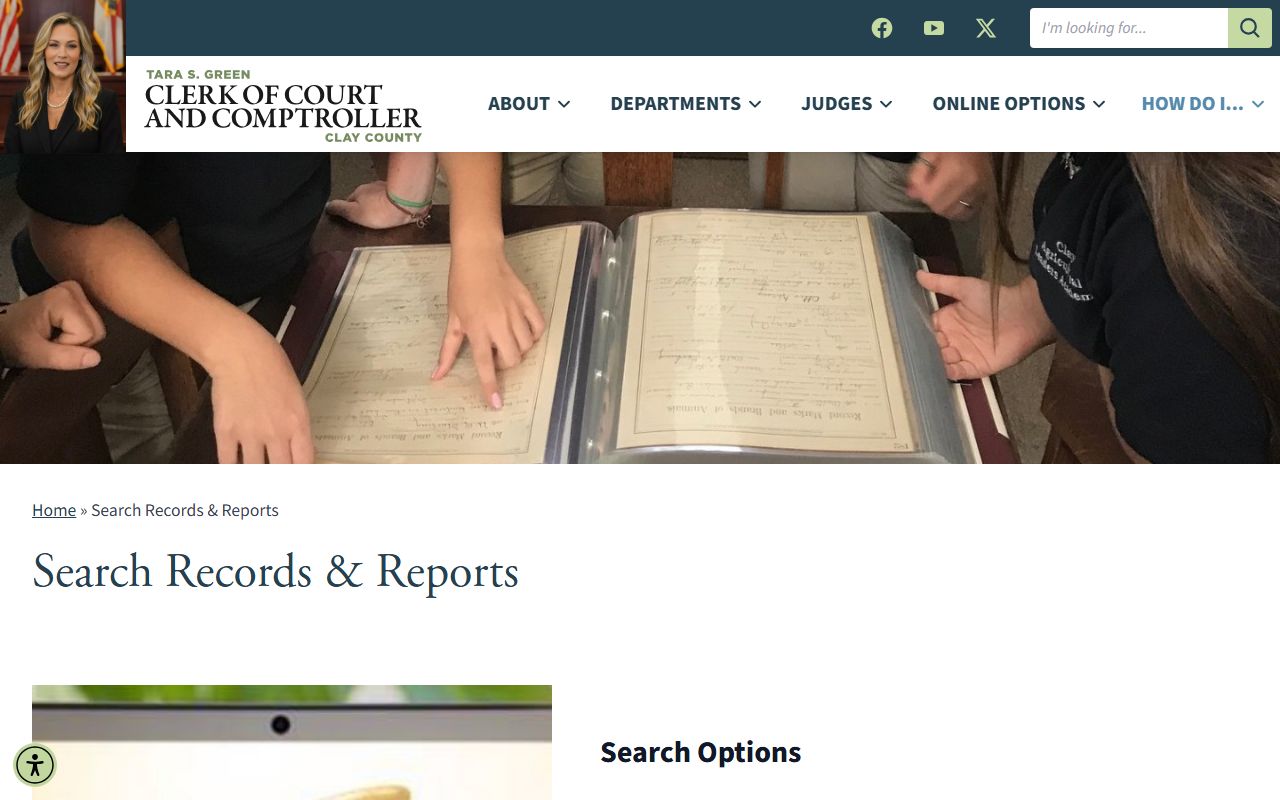
From that page the inquiry portal handles the actual case lookup, while the criminal department covers questions a search box cannot answer. A formal court case may include the case number, the defendant name, the filing date, the charges and counts, the court division and judge, hearings and events, bond orders, warrants, pleas, the disposition, and any financial obligations. Exact fields should be confirmed in the live portal, since the layout is maintained by the Clerk and the screenshot inspection was limited.
For criminal-specific routing, the Clerk runs a dedicated unit for these files. A look at the Clerk's Criminal Court Services page shows where in-person and phone help for criminal cases is directed.
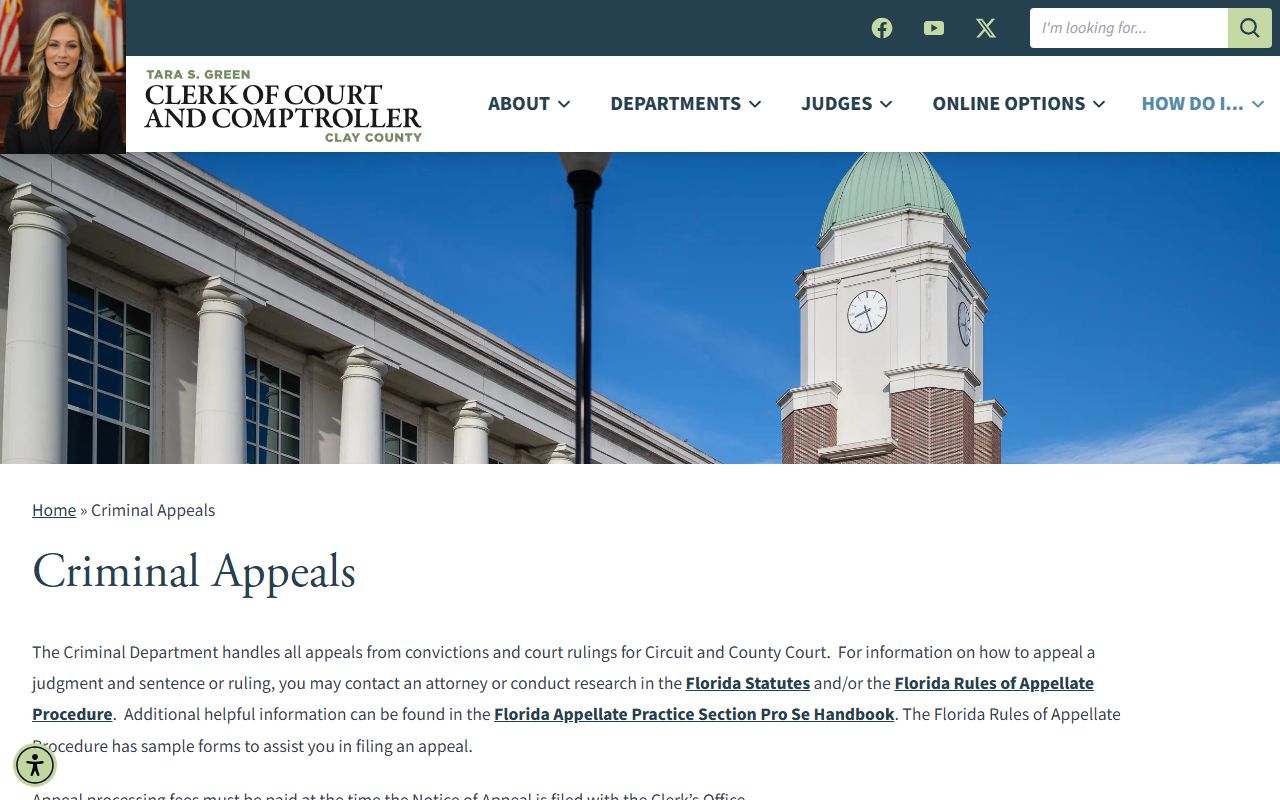
That criminal services page is the contact point when a case is hard to find online, when documents are older than the portal shows, or when a record may be sealed. For prosecution-side files rather than court filings, the State Attorney handles those requests on its own channel.
The Prosecutor Behind the Charges
The prosecutor decides the charges, so the State Attorney's role sits at the center of any court record after an arrest. Law enforcement books the person and submits reports. The State Attorney for the Fourth Judicial Circuit then reviews the case and chooses to file, decline, amend, reduce, add counts, divert, or prosecute. Because the office serves Duval, Clay, and Nassau, the title is State Attorney rather than district attorney, and the Clay work falls under the circuit office and its Clay County location.
The Clay County office is reachable through the State Attorney's site. The State Attorney's Clay County office page is the local point of contact for prosecutor matters and for the office's public-records process. Florida's broad public-records law also reaches written correspondence sent to the office, so anything confidential or exempt should be flagged by the sender. For court filings themselves, though, the Clerk remains the custodian, and the State Attorney handles prosecution records.
Note: Filed charges live in the court record and can differ in wording and timing from the booking charges shown on the jail roster.
Background Checks and Court Records
People use court records after an arrest for different reasons, and the reason matters. A casual lookup to track a relative's case is one thing. A formal background check used to make a hiring, housing, or credit decision is another, and it falls under the federal Fair Credit Reporting Act. That law requires a regulated consumer reporting agency, specific consent, and dispute rights. A raw public-records search does not meet those rules and should not be used as if it does.
Important: This is not a consumer reporting agency under the FCRA, and the records here may not be used for credit, employment, housing, or insurance screening.
Restricted Clay County Court Records
Not every record after an arrest is open. Florida's public-records law is broad but not absolute. Florida Statutes Chapter 119 sets the general right to inspect and copy agency records, while specific exemptions limit disclosure of certain categories. Juvenile arrest information, sealed charges, expunged cases, confidential victim data, protected addresses, and active investigations can all be withheld or redacted. A court record search may simply return nothing for these, and that absence does not mean an arrest never happened.
When a record is exempt online, the path forward is the right office and the right request, not a guess. The Clerk handles court files and can explain why a case is restricted. The Sheriff's public-records section handles booking and arrest records subject to the same exemptions. Each office applies Florida law to decide what may be released, and counsel can advise where a sealed or expunged matter is involved.